
Data science teams love their own tools and they shouldn’t have to give them up to get access to real compute. That’s the idea behind a new integration we’ve built together with Posit: a Launcher plugin that lets Posit Workbench run both interactive data science sessions and batch jobs directly on clusters managed by Gridware Cluster Scheduler.
What is Posit?
Posit (formerly RStudio) is the company behind the most widely used tools in the R and Python data science ecosystem. Its enterprise platform, Posit Workbench, gives data scientists a single, easy to use, browser-based place to do their work. Backed by centralized security, credential management, and access controls that IT teams can actually govern.
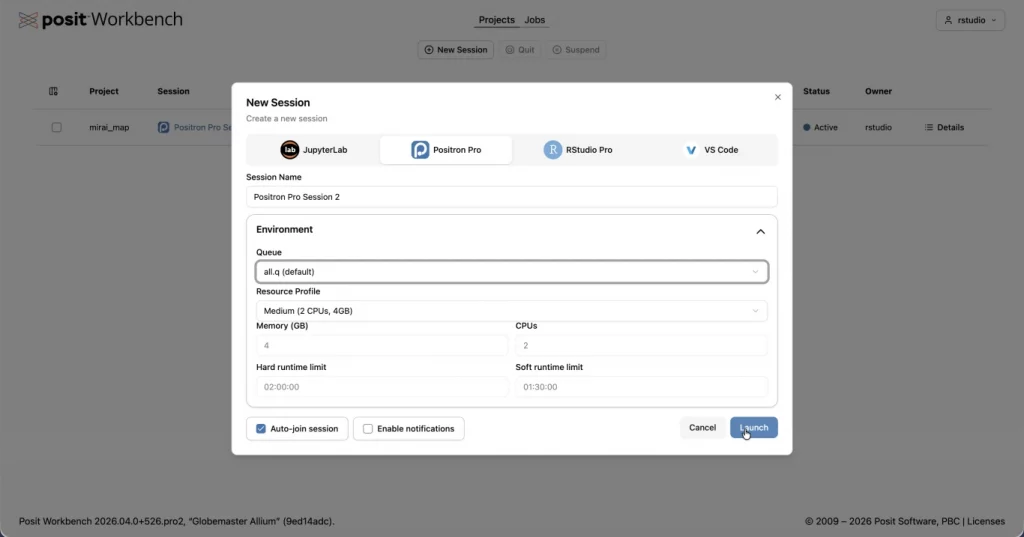
The part that matters most for cluster operators: Workbench doesn’t tie users to one editor. From a single login, a data scientist can spin up the interactive environment they prefer:
- Positron — Posit’s next-generation, multilingual data science IDE for R and Python
- RStudio Pro — the professional edition of the classic RStudio IDE
- Jupyter Notebook / JupyterLab — for notebook-driven Python and R workflows
- VS Code — for teams that live in the Microsoft editor
And it doesn’t stop at interactive work. From within Workbench, users can also push batch jobs – long-running scripts, model training runs, scheduled pipelines – onto the cluster, so heavy compute runs as a separately managed job instead of tying up an interactive session.
Why run sessions and jobs on the cluster?
On a laptop or a single shared server, these tools are limited by whatever hardware happens to be underneath them. The value of running them on a Gridware Cluster Scheduler managed cluster is that every interactive session and every batch job becomes a properly scheduled job:
- Real compute, on demand. Need 32 cores, 256 GB of RAM, or a GPU? Pick a resource profile and your Positron, RStudio Pro, Jupyter, or VS Code session — or a submitted batch job — launches straight onto cluster nodes that can deliver it.
- No scheduler syntax required. Administrators define named profiles (like “Small”, “Medium”, “GPU”) that map to specific CPU, memory, and GPU allocations. Users just choose one; the plugin translates it into the right request for the scheduler.
- Fair, governed resource use. The same user and group limits, GPU policies, and parallel environments (SMP, MPI) that govern the rest of your cluster apply to Workbench sessions and jobs too.
- Reproducible environments. Sessions and jobs can run inside Singularity/Apptainer containers, so everyone works from the same, well-defined stack.
- One place to work. Submit, monitor, suspend, resume, and terminate both interactive sessions and batch jobs without leaving the familiar Workbench interface.
The result is the best of both worlds: data scientists keep the editor they know, and your cluster handles scheduling, isolation, and resource management the way it always has.
Read the full announcement
This plugin is the product of a collaboration between Posit’s Solution Engineering organization and HPC Gridware. It works with Gridware Cluster Scheduler, the open-source Open Cluster Scheduler, and other Sun Grid Engine (SGE) – compatible environments. For the technical details, requirements, and current status, see the full announcement: Announcing the Gridware Cluster Scheduler Launcher Plugin for Posit Workbench.
Interested? Let's talk.
The plugin is ready for testing today. If you’re running Gridware Cluster Scheduler or any SGE-compatible scheduler and want to evaluate it or just have questions about HPC integration with Posit Workbench – get in touch:
- Michael Mayer — Principal Solution Engineer, Posit michael.mayer@posit.co
- Daniel Gruber — Co-Founder & Chief Solutions Officer, HPC Gridware dgruber@hpc-gridware.com
We’d love to hear how this can fit into your team’s data science workflows.