
9.1.8 is the release where Qontrol stops being only a configuration tool. It now shows what the cluster is doing right now and lets an administrator act on it. Underneath, TLS learns OpenSSL 4, the systemd integration gets strict about memory limits, rescheduling is more robust, and a long list of security fixes lands in the 9.1 line. Here is what matters.
Qontrol: see what the cluster is doing, and act on it
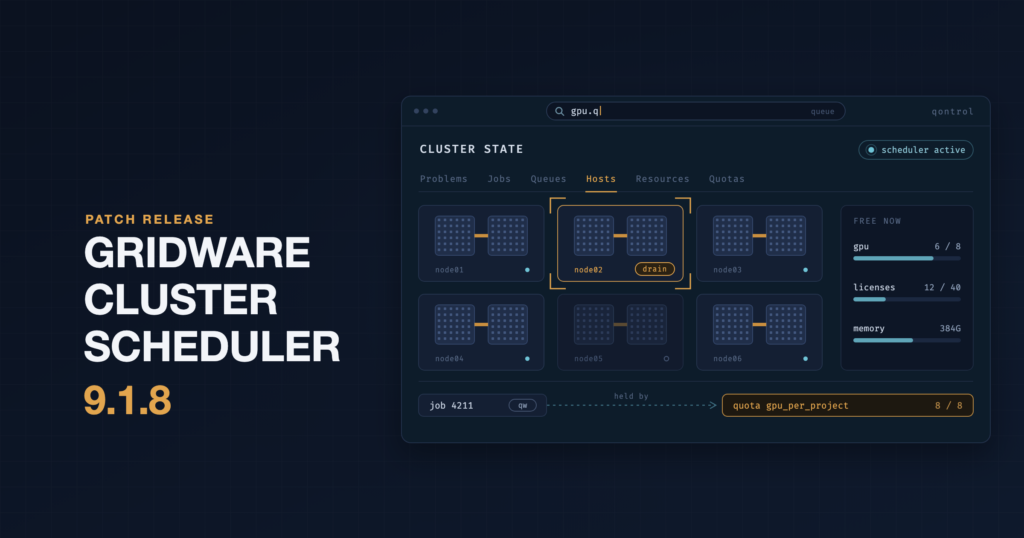
Qontrol, the web-based replacement for qmon, has so far covered the configuration of a cluster. With 9.1.8 it also answers the questions that otherwise take a series of qstat, qhost and qquota calls: is the scheduler running, which hosts are in trouble, why is this job not starting, and what is free at the moment?
The new Cluster State view brings that together:
-
- Scheduler status. The header shows whether the scheduler is active. A manager can start it from there.
-
- Hosts. Each host is shown with its state. An administrator can drain a host, so that it takes no new jobs while the running ones finish, and clear it again afterwards.
-
- Queues. A searchable overview of the state of the queue instances.
-
- Jobs. Clear the error state of a job, hold and release it, reschedule it, or delete it, without leaving the view.
-
- Resource quotas. The usage of each quota is shown, and so is the case where a quota is what keeps a job from starting.
-
- Free resources. What is free now: licenses, GPUs, consumable memory.
All tabs share one look, so hosts, queues and jobs read the same way. The actions can be limited to users who hold the corresponding rights in the cluster; everyone else sees the state but cannot change it.
That last point about quotas deserves a second look. “Why is this job pending?” is the most frequent question any cluster administrator gets, and a resource quota is one of the least visible answers. Cluster State puts it on the screen.
Everything Cluster State shows is also available through the REST API and as new MCP tools, so scripts and AI assistants see the same picture as the administrator.
(Available in Gridware Cluster Scheduler only.)
Qontrol: search, and a share tree that shows its effect
Two further additions help an administrator find their way around.
A search bar. It leads to any page of Qontrol and to any cluster object. A queue, a host, a resource, a job, or any configuration page is reached by typing its name instead of going through the menu.
Configured vs. actual share. The Share Tree page now shows the configured share of each node next to the actual one, so you see at a glance whether the policy has the effect it was meant to have.
Qontrol also catches up with 9.1.7: AUTO_ADD_HOSTS and AUTO_REMOVE_HOSTS_AFTER can be set in the UI, and an advance reservation can choose its PE allocation rule. The built-in MCP server now finds jobs in combined states such as Eqw and hqw in all available tools, so an AI assistant asked about a stalled job in a combined state can actually locate it.
(Available in Gridware Cluster Scheduler only.)
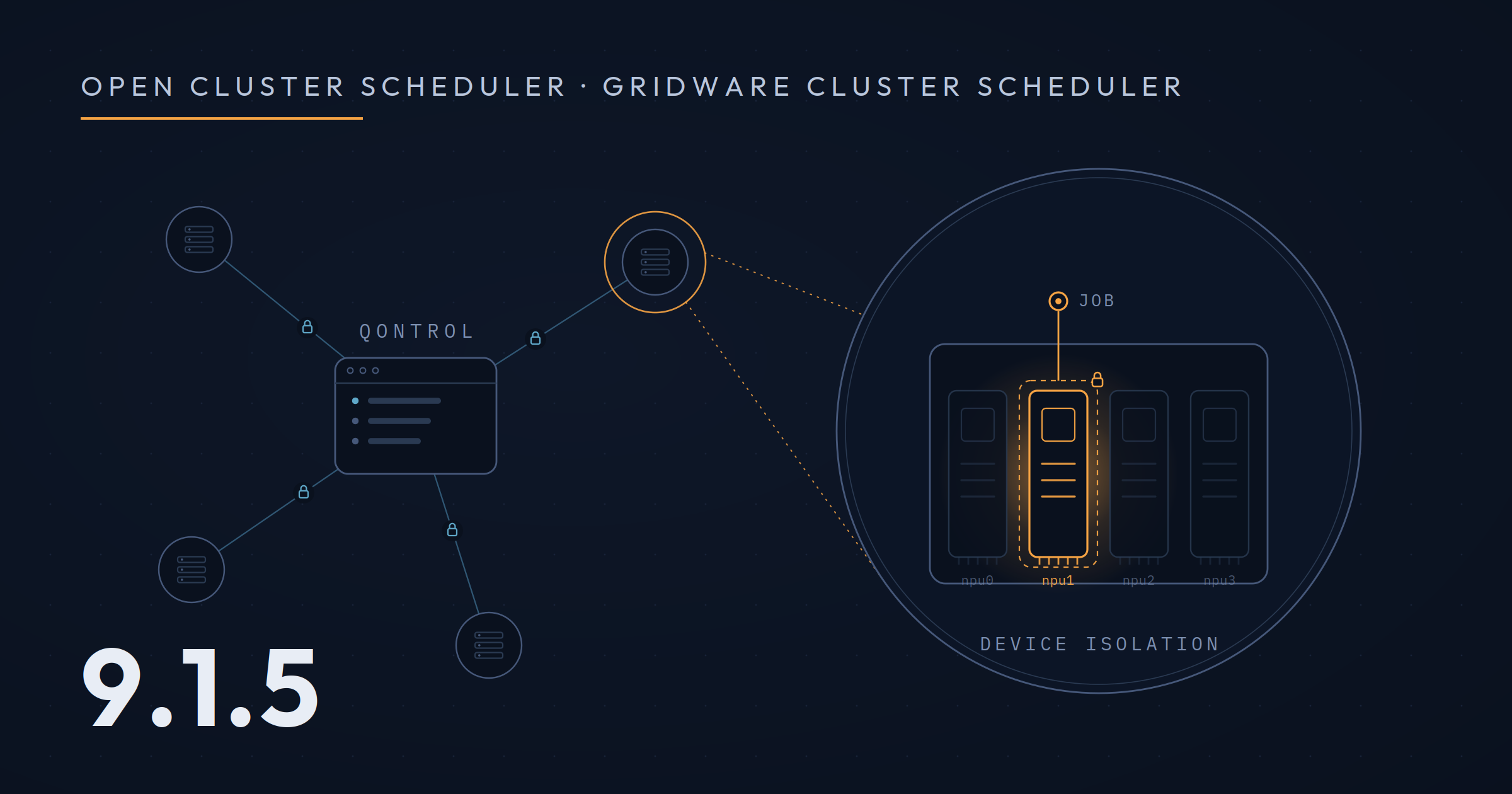
TLS with OpenSSL 4
TLS encryption of the component communication now also works with OpenSSL 4. The components load OpenSSL 4 if it is installed on a host, otherwise OpenSSL 3. A cluster can contain both, so there is no need to move every host at once when a distribution upgrade brings the new library along. At startup, sge_qmaster and sge_execd log which OpenSSL library they loaded.
The TLS layer itself was hardened as well. A client that connects without ever sending a TLS handshake no longer blocks the daemon and lets the requests of all other clients time out; an incomplete handshake is continued from the regular event loop instead.
See the Installation Guide, chapter “Enabling TLS Encryption”.
(Available in Open and Gridware Cluster Scheduler.)
Memory limits under systemd: one outcome, clearly recorded
On a host that runs its jobs under systemd control, the lower of h_rss and h_vmem becomes the MemoryMax of the job’s scope. Until now, when a job reached that limit the kernel killed one of its processes, and the job carried on with whatever was left and finished with its own exit status. A job that silently lost a worker is worse than a job that failed.
9.1.8 makes the outcome unambiguous:
-
- On hosts with cgroup v2 and systemd 252 or newer, the job scope is started with
OOMPolicy=kill. The OOM killer ends all processes of the job at once, and the job ends as failed.
- On hosts with cgroup v2 and systemd 252 or newer, the job scope is started with
-
- The accounting record shows who ended it:
deleted_by oom-killer@<host>. A workflow manager can now tell an OOM kill from any other failure.
- The accounting record shows who ended it:
-
- Failed job scopes are reset after the epilog has run. They no longer pile up in systemd, and a later job with the same id no longer fails to start because of one.
-
- How
MemoryMaxandMemoryHighof the job scope are derived is now configurable.
- How
-
- The job environment contains the name of its systemd scope in
SGE_JOB_SCOPE, andsge_execdlogs which systemd related features are not available on its host.
- The job environment contains the name of its systemd scope in
Jobs that used to survive the OOM kill of one of their processes now end as failed. That is the point of the change, but it is a change, so it is listed in the upgrade notes.
(Available in Open and Gridware Cluster Scheduler.)
Limits of parallel jobs, computed once
Queue limits such as h_cpu, h_vmem or h_rss are limits per slot. For parallel jobs, sge_execd and sge_shepherd used to compute the limit of a task in different ways: some limits were multiplied by the number of slots, some were not, and with master_forks_slaves or daemon_forks_slaves some were multiplied twice.
Now the execution daemon computes the limit of each task once and the shepherd applies it as it is. The master task of a loosely integrated parallel job, the master task with master_forks_slaves and every slave task with daemon_forks_slaves get the limit multiplied by the number of slots of the job on that host. Every other task gets the limit of a single slot.
The consequence: some tasks of tightly integrated parallel jobs get a lower limit than before, and a task that exceeds its new limit is killed. If you run tightly integrated parallel jobs with queue limits, read the upgrade notes before you upgrade. The rules are documented in sge_queue_conf(5).
(Available in Open and Gridware Cluster Scheduler.)
Rescheduling you can rely on
qmod -r got a round of fixes for the cases that only show up on a busy cluster. The old run of a rescheduled job is reliably stopped, also across a restart of sge_qmaster, and its late reports are no longer taken for reports of the new run. The scheduler defers the start of the new run as intended, and a rescheduled task of a tightly integrated parallel array job no longer hangs in state Rt when it is dispatched to a host where one of its old slave tasks is still running.
Security hardening and CRA
A large part of this release is a hardening pass over the code base, including a backport of the security fixes made for 9.2. Among them: a race in qstat that allowed reading arbitrary files, unescaped strings in the XML output of qrstat, world-writable files and an unvalidated path component in the flatfile spooling, a GDI request that was executed although the sender had been refused, and a series of buffer and integer overflows in the clients and daemons.
On the compliance side, CVE monitoring is now automated, the core SBOM carries CPEs for its C/C++ components, and dbwriter moves to jackson 2.18.12.
If you run 9.1.x, this alone is a reason to upgrade.
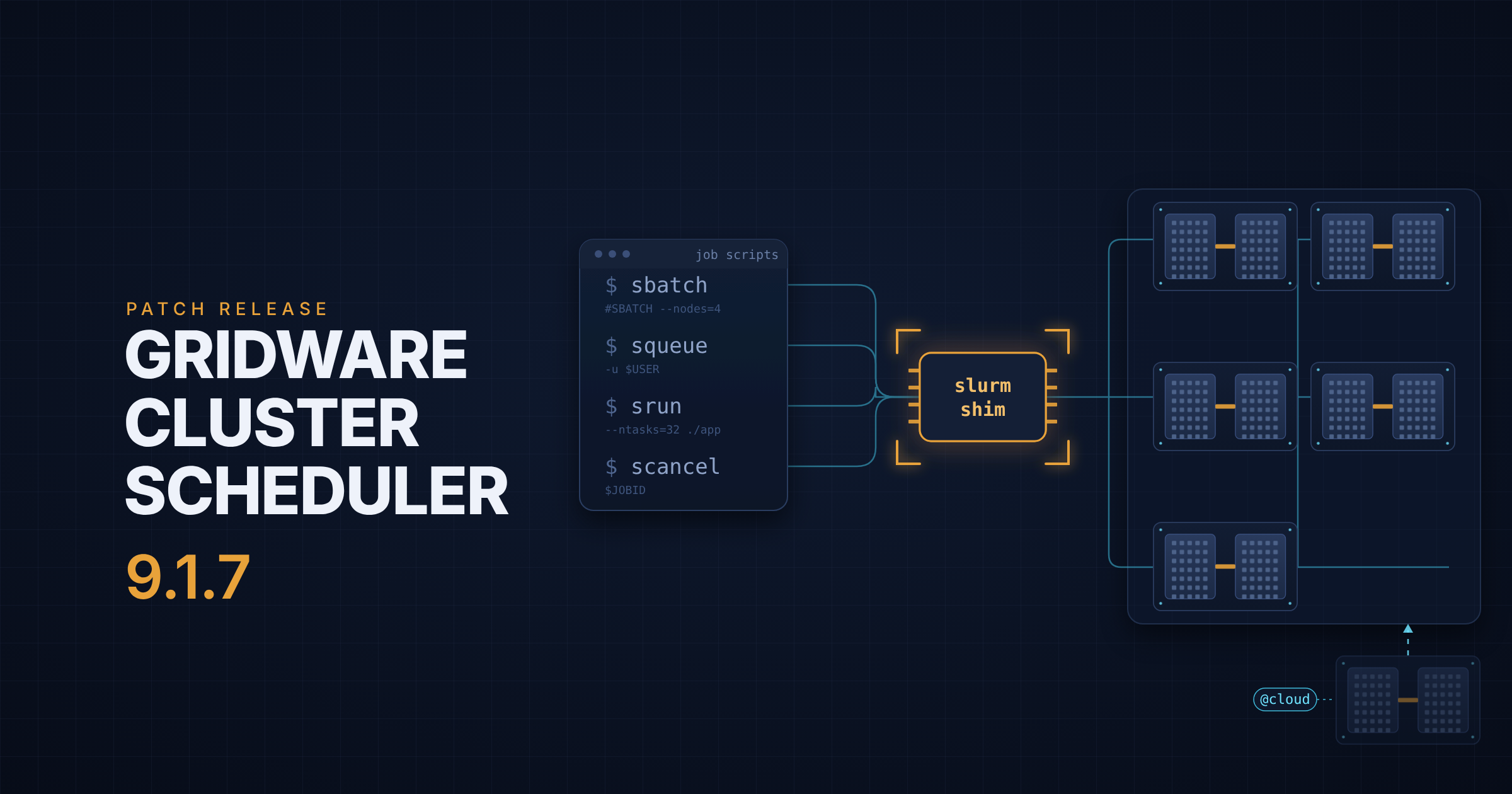
slurm-shim keeps growing
The shim introduced with 9.1.7 picks up experimental PMIx support for MPI, support for dagster-slurm so that Dagster assets run as cluster jobs, and fixes for srun step placement and for mpirun of an OpenMPI built with both SGE and Slurm support.
Fixes all round
qstat -j now honours the user filter -u. Accounting shows that a tightly integrated parallel job ended at its h_rt limit, and custom usage values in qacct -j are reported correctly when several jobs are listed. Backup and restore with PostgreSQL spooling keeps the job and reservation sequence numbers, and a normal sge_qmaster shutdown no longer skips the final spooling, so ids cannot be handed out twice after a restart. An AUTO_ADD_HOSTS rule with a plain host name now matches when ignore_fqdn or a default_domain is set. Advance reservations can be submitted where queue access is controlled via projects, and deleting a reservation with core binding releases the reserved cores.
One note for newer distributions: on systems that replaced GNU coreutils with the Rust rewrite, Ubuntu 25.10 and later among them, id and groups exit with an error inside a job because the additional group id of a job has no name. The release notes describe what to do; in scripts, id -un and id -G are the portable choice.
Upgrading
9.1.8 installs over any 9.1.x installation. Before you upgrade, read the two upgrade notes for this release: the limits of parallel jobs, and jobs reaching their memory limit under systemd. Both change what happens to a job that exceeds its limits. If you are coming from 9.1.4 or earlier, the notes on the TLS key location and the LimitNOFILE setting in the qmaster unit file still apply.
We would love to hear what you look at first in Cluster State, and what you would like to see there next.
Download Open Cluster Scheduler from our download portal: https://open.clusterscheduler.io and Gridware Cluster Scheduler from our internal customer download portal.